Studio Window No. 10
Your about page is still about your client
ELYSA - ERANOVA DESIGN JUNE 22 2026 11 MIN READ FREE TEMPLATE INSIDE
Some wellness practitioners write their about page like a resume. A list of certifications. The story of how they found their path. A paragraph about their philosophy that mostly makes sense but does not quite land. Then a photo. The page is written by someone and for someone, but somehow the visitor still does not know if this is the right person to work with.
That is the problem. And it has nothing to do with your credentials.
This post is about how to write an about section that actually builds trust. What to include, what to leave out, the five-step structure that works for wellness practitioners at every stage, and the most common mistake that makes even well-written about pages fall flat.
— THE MISTAKE ALMOST EVERY WELLNESS PRACTITIONER MAKES —
The mistake that makes some wellness pages not work
The mistake is treating your about page like a biography. A place to document your training, your path, your credentials, your philosophy. All of those things can appear on an about page. But if they are the first things your visitor encounters you have already lost them.
The visitors who land on your about page are not there to read your story. They are there to answer one question: is this the right person to help me? Your job is to answer that question as quickly and clearly as possible. Everything else is supporting evidence.
“Your about page is not a place to list what you have done. It is a place to show someone that you understand where they are.”
— WHAT THE ABOUT SECTION IS ACTUALLY FOR —
What a wellness about section is actually supposed to do
A well-written wellness about section does three things. Most practitioners only do one of them. Understanding all three changes how you approach every sentence you write.
- It earns trust by showing you understand the problem your client is living with right now
- It earns credibility by showing you have the experience and training to help
- It earns connection by letting your personality and perspective come through clearly
Some wellness practitioners spend ninety percent of their about page on the second job and almost nothing on the first or third. The result is a page that communicates competence but not understanding and not personality. Competence alone does not build enough trust to make someone reach out.
All three need to be present. And they need to be in this order. Trust first. Credibility second. Connection woven throughout.
— THE FIVE STEP FORMULA —
The formula for a wellness about section that actually builds trust
This is not a rigid template. It is a sequence. Follow the logic and you can write it entirely in your own voice.
Start with a line that names their situation. Not what you do. Not who you are. What they are dealing with right now. The more specifically you can name their experience the more powerfully they will feel seen. This is the moment that makes someone think this person gets it.
Once they feel seen, bring in your story. But only the part of your story that is directly relevant to their problem. Why do you understand what they are going through? What led you to this work? Your origin story earns its place on your about page when it connects to your client's experience, not when it stands alone.
This is where your philosophy lives. Not a list of services. Not a summary of your training. A belief. Something you hold true about this work and why it matters. A single well-written sentence about what you believe can do more trust-building work than three paragraphs of credentials.
One clear sentence. Who is the person who gets the most out of working with you? Name them specifically enough that the right person feels called in and the wrong person self-selects out. Specificity here is not exclusion. It is the clearest signal you can send to the person you are trying to reach.
End with a calm, clear invitation. Not a hard sell. Not urgency. Just: here is where to go from here. Link to your services page, your contact page, or wherever the most natural next step is for your ideal client. The about page earns the click. The next page does the rest of the work.
— WHAT TO LEAVE OUT —
What wellness practitioners include that does not need to be there
Editing your about page is as important as writing it. Here are the things that appear on most wellness about pages that do not need to be there.
- The full history of your certifications. One clear line naming your most relevant credential is enough.
- Your entire origin story. Only the part that connects to your client's experience belongs here.
- Vague words like passionate, dedicated, and holistic. Say what you mean specifically.
- A complete list of every modality you are trained in. Your services page handles this more effectively.
- Anything that starts with I in your first paragraph. Your first sentence should be about your client, not about you.
— WHAT THIS LOOKS LIKE IN PRACTICE —
The difference between an about section that lists and one that connects
Here is what the same practitioner sounds like before and after applying this approach.
"Hi, I'm Sarah. I am a certified yoga instructor and wellness coach with over ten years of experience. I am passionate about helping people live healthier, more balanced lives through movement, mindfulness, and intentional living."
"Most of my clients come to me after years of trying to figure out why they feel exhausted even when they are doing everything right. I have been there too. That is what this work is built on."
The stronger version is shorter. It uses no credentials. It does not even name the practitioner's modality. And it is doing significantly more trust-building work than the longer version because it leads with understanding rather than accomplishment.
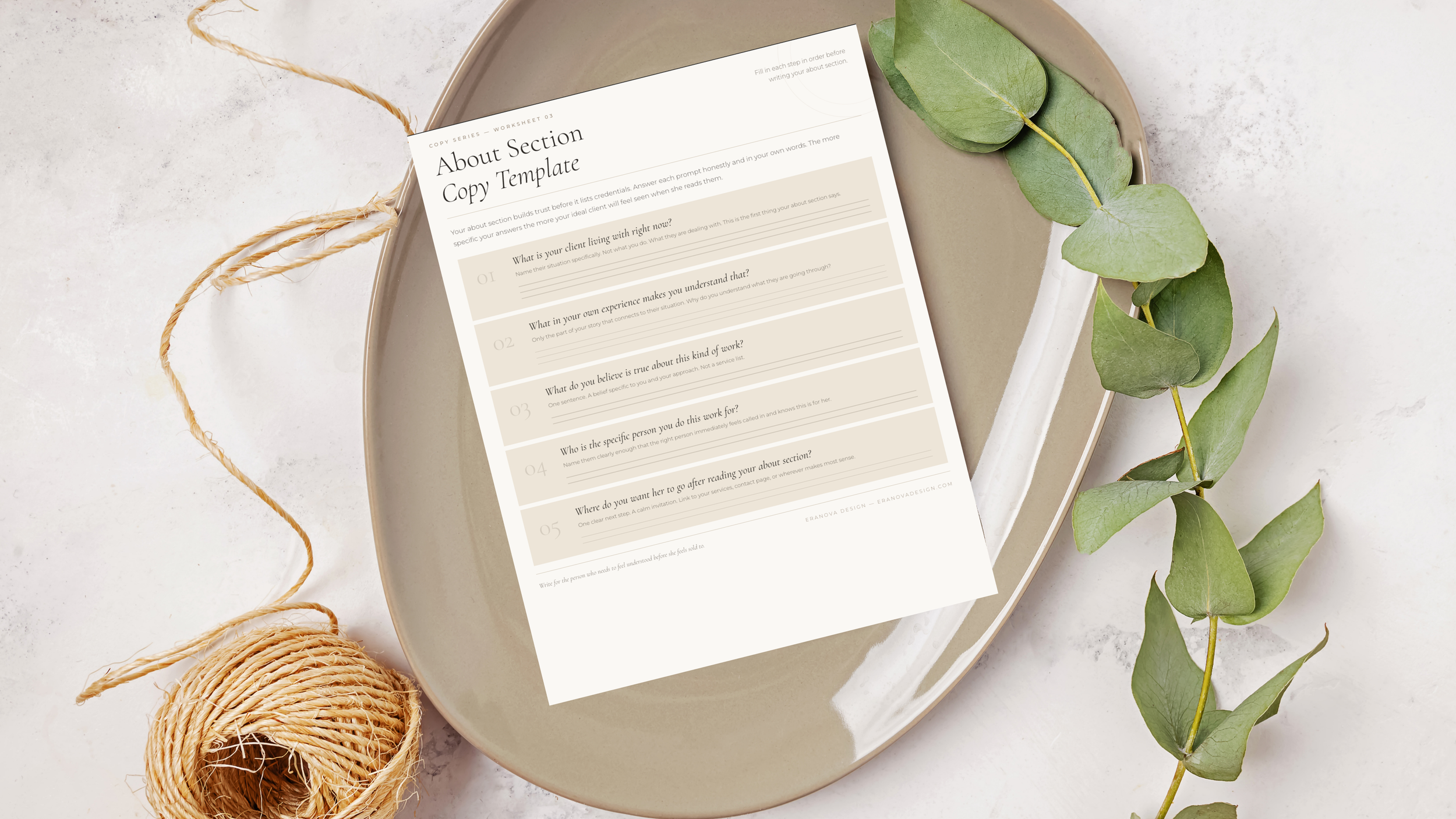
About Section copy template
The full Copy Series workbook, How to Write Your Wellness Website, brings every post in this series together into one guided resource. Coming soon to Gumroad.
Browse the collection