Studio Window No. 09
How to write a wellness business card that actually works
ELYSA - ERANOVA DESIGN JUNE 15 2026 13 MIN READ FREE CHECKLIST INSIDE
Your wellness business card is doing more work than you realise. It is the first physical thing someone holds after meeting you. And in the wellness space where trust is everything that small rectangle of card stock is communicating something about your brand before the person has even read your name.
Most wellness business cards fail silently. Not because the information is wrong but because nobody thought carefully about what to include, how to say it, or how to make the card feel as considered as the work it is representing. The result is a card that gets glanced at and set aside rather than kept and referred to.
This post covers everything you need to know to create a wellness business card that actually works. What information to include and what to leave out. How to write your title so it communicates clearly to your ideal client. What design principles make a wellness business card look professional and premium. And the most common mistakes wellness practitioners make on their cards and how to fix every one of them.
— WHAT YOUR WELLNESS BUSINESS CARD IS ACTUALLY DOING —
The job your wellness business card is actually doing
Before you can design a good business card you need to understand what it is actually supposed to do. Most people think the job of a business card is to give someone your contact information. That is part of it. But it is not the whole job and it is not the most important part.
The most important job of a wellness business card is to make someone want to keep it. That sounds obvious but think about how many business cards you have received that you threw away. What made you throw them away? Usually it was not that the information was wrong. It was that the card did not feel like something worth keeping. It did not reflect a brand you wanted to remember. It did not make you feel like the person behind it had thought carefully about their work.
A business card that gets kept is one that communicates something beyond contact details. It communicates care. It communicates intentionality. It communicates that the person who handed it to you is the kind of practitioner who thinks about every detail of the experience they create. In the wellness space that signal is worth more than any amount of information you could fit on the card.
“The goal of your wellness business card is not to give someone your phone number. It is to make them want to call it.”
This reframe changes how you think about every decision on the card. The question is not what information should I include. The question is what will make this card feel worth keeping and what will make the person who picks it up three days later immediately remember why they took it.
— THE DIFFERENCE IN PRACTICE —
What to include on a wellness business card and what to leave out
Less is almost always more on a wellness business card. The temptation is to include everything your name, your title, your certifications, your website, your email, your phone number, your Instagram handle, your studio address, a QR code, and your tagline. The result is a card that feels overwhelming and communicates the opposite of the calm intentional brand you are trying to build.
Here is a clear framework for what belongs on each side of the card.
The front of your wellness business card
The front of your card has one job. Make someone remember who you are and what you do clearly enough that when they find the card three days later they immediately know why they kept it. Everything on the front should serve that job and nothing else.
- Your name. First and last, in the largest text on the front of the card.
- Your title. One clear line describing what you do and who you do it for.
- One primary contact method. Either your website or your email, not both.
- Your phone number if you take client calls directly.
- Your logo or wordmark if you have one.
Notice what is not on that list. Your Instagram handle does not belong on the front of your card. Your QR code does not belong on the front. Your list of certifications does not belong on the front. Your tagline probably does not belong on the front either unless it is truly exceptional and genuinely communicates something a visitor cannot get from your name and title alone.
The back of your wellness business card
The back of your card is where your brand identity lives. This is where the visual language of your brand gets to breathe. A strong back of card feels like a reveal — when someone flips it over they should feel like they are seeing something considered rather than finding a second page of information.
The most effective back of card treatments for wellness brands are either a strong brand visual a pattern, a color field, a single image with minimal or no text, or a single line of copy that captures the feeling of your brand. Your tagline if you have one that is genuinely good. A short sentence that names what you do in a way that feels human rather than clinical.
— HOW TO WRITE YOUR TITLE ON A WELLNESS BUSINESS CARD —
How to write your title on a wellness business card so it actually communicates
Your title is the most underused space on most wellness business cards. Most practitioners either list their certification: Certified Somatic Therapist, RYT 500, Board Certified Nutritionist, or they use a vague descriptor that says nothing specific: Wellness Coach, Holistic Practitioner, Healing Arts.
Both approaches have a problem. The certification approach leads with your credential rather than your client's need. It tells the person holding your card what you are rather than what you do for them. The vague descriptor approach is so broad it fails to differentiate you from anyone else in your space.
A title that works on a wellness business card does one or both of two things. It names who you serve specifically, or it names what changes as a result of working with you. Here are examples of how that shift looks in practice.
Instead of Breathwork Facilitator try Breathwork for Women in Burnout. Instead of Holistic Nutritionist try Nutrition for Postpartum Recovery. The more specific you are about who you serve the more powerfully the right person will recognise themselves. Specificity feels exclusive but it actually attracts more of the right clients by making them feel seen immediately.
Instead of Somatic Therapist try Somatic Therapy for Nervous System Recovery. Instead of Sound Healer try Sound Healing for Stress and Sleep. Adding what you actually help your client achieve gives your title a destination rather than just a description. It tells the person holding your card not just what you do but what they can expect to experience as a result of working with you.
Your title should be readable at a glance. One line of text at a comfortable size. If your title is so long it needs to wrap to a second line it is trying to do too much. Cut until it fits on one line. The constraint will force you to identify what is most important about what you do and say only that.
— DESIGN PRINCIPLES FOR A WELLNESS BUSINESS CARD —
Design principles that make a wellness business card look professional and premium
The design of your wellness business card communicates as much as the words on it. A card that feels visually considered signals that you are the kind of practitioner who thinks carefully about every aspect of the experience you create. A card that feels visually generic signals the opposite before a word has been read.
These principles apply whether you are designing your card from scratch, customising a template, or working with a designer.
Your business card should use exactly the same colors as your website, your social graphics, and your other brand materials. Not similar colors. Not colors you found on a card template that you liked. Exactly the same hex codes. Color consistency across every touchpoint is what makes a brand feel designed rather than assembled. When someone who has been on your website picks up your card and immediately recognises the colors that recognition builds trust before they have spoken to you.
Same principle as colors. Your business card should use exactly the same fonts as everything else in your brand. One serif for your name and any display text. One sans serif for your title, contact details, and any supporting information. If the font on your business card does not match the font on your website your brand is inconsistent and inconsistency costs you trust even when the person holding your card cannot consciously name what feels off.
Your name is the most important element on your business card and it should be treated that way. It should be the largest text on the front of the card. It should have generous space above and below it so it does not feel crowded by your title or your contact details. The space around your name is not wasted space. It is giving your name the visual weight it deserves and signalling to the person reading it that this is the most important thing on the card.
The physical quality of your business card communicates as much as its design. A thin flimsy card immediately undermines the premium feeling you are trying to create regardless of how beautiful the design is. A thick card with a soft matte finish or a subtle texture communicates quality the moment someone picks it up. For wellness brands specifically a matte or uncoated finish tends to feel more aligned with the organic intentional aesthetic than a glossy finish which reads as corporate and clinical.
— COMMON WELLNESS BUSINESS CARD MISTAKES —
The most common wellness business card mistakes and how to fix them
Your hero headline is the door. But the rest of your hero section is the room. Once your headline has stopped someone and made her feel seen the remaining elements each have a specific job to do.
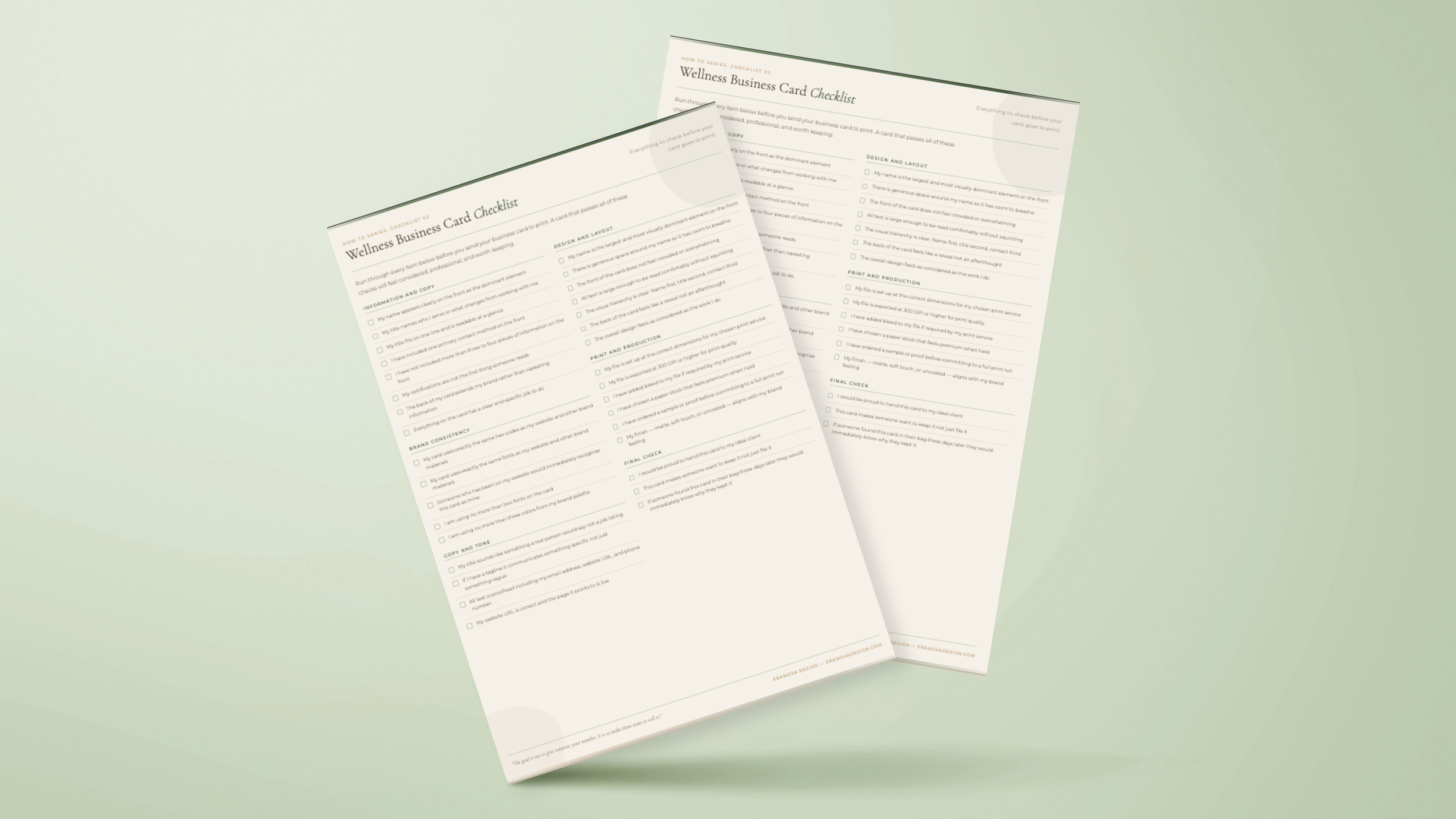
Before creating your wellness business card cover each design decision point.
— PUTTING IT ALL TOGETHER —
A wellness business card that gets kept
The business cards that get kept are not the ones with the most information on them. They are the ones that feel like they belong to a brand worth remembering. A brand that thought about the experience of receiving the card as carefully as it thought about the experience of working with the practitioner.
That is the standard to hold your card to. Not does this have all my information. But does this feel like something someone would want to keep. Does it communicate care before it communicates credentials. Does the person who picks it up feel like they are holding something that was designed on purpose.
Before you order your next batch of cards run through the free checklist below. It covers every decision point from information and copy to design and print. Everything should be checked before your card goes to print.
The Eranova Design business card template collection is built on every principle in this post. Browse the Wild and Rooted, VERAsol, and Soulé Bali business card templates.
Browse the templates