Studio Window No. 05
5 design trends your wellness brand should be paying attention to right now
ELYSA - ERANOVA DESIGN MAY 20 2026 7 MIN READ
Design trends are not about chasing what is new. They are about understanding what is resonating with people right now and asking whether any of it belongs in your brand.
I spend a lot of time looking at what is working in wellness and executive coaching design. Not because I think every brand should follow trends, most should not. But because trends reveal something about what people are responding to emotionally. And in branding, emotional response is everything.
The five trends I am watching right now are not arbitrary. They are all moving in the same direction, toward more humanity, more restraint, and more confidence. And every one of them is within reach for a small wellness or coaching brand without a big budget or a custom designer.
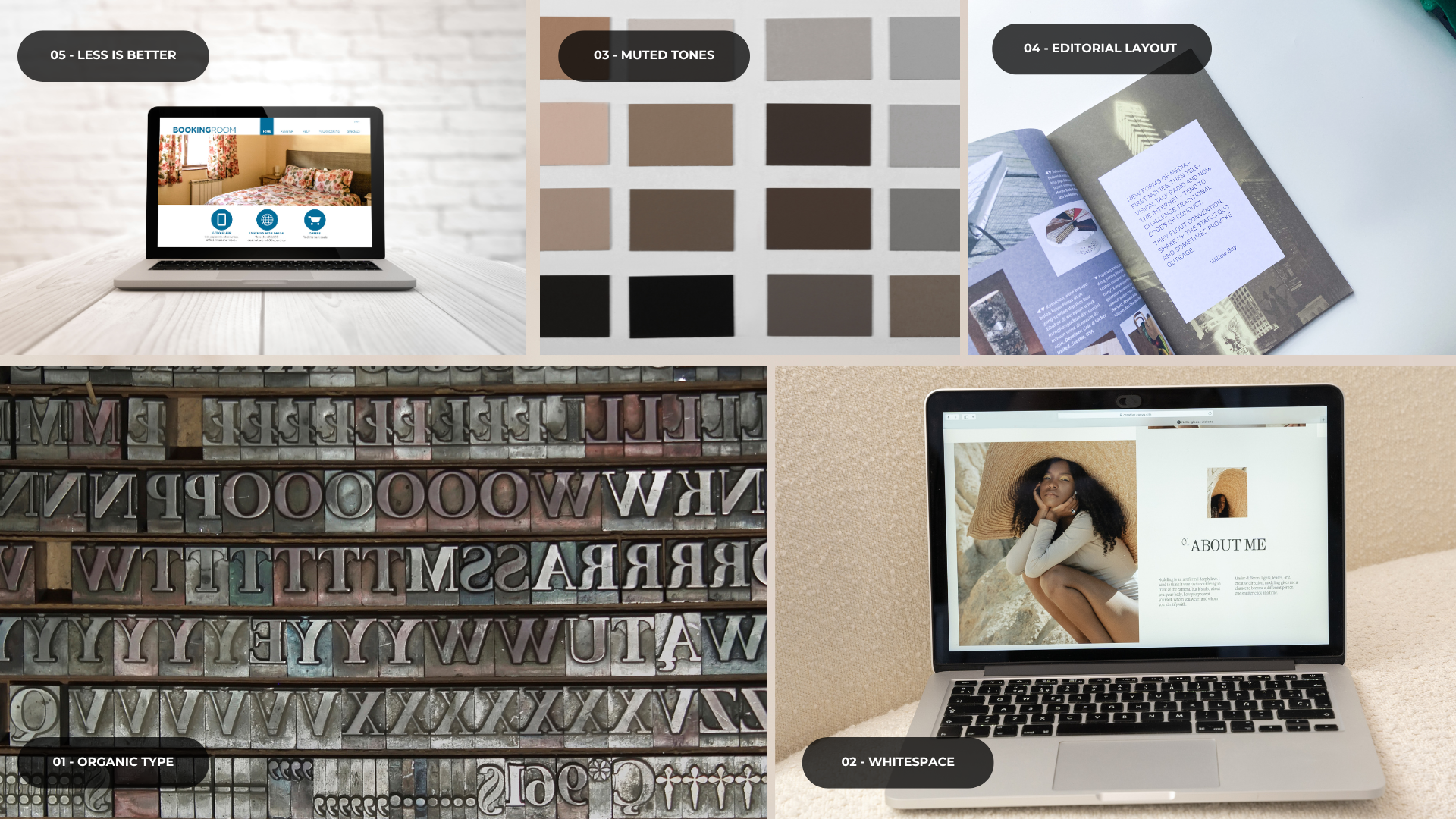
5 trends your wellness or coaching brand should be paying attention to right now.
— THE FIVE TRENDS —
For the last decade clean geometric sans serifs dominated wellness branding. Circular. Futura. Proxima Nova. Everything felt sharp, modern, and slightly corporate. That wave is turning. The brands that are standing out right now are the ones using serif fonts with character, typefaces that feel like they were drawn by a human hand rather than plotted by an algorithm.
Think of the difference between a typed label and a handwritten one. The handwritten one communicates care, specificity, and presence. Organic serifs do the same thing digitally. They suggest that someone made considered choices rather than just defaulting to whatever font came with the website template.
What this means for your brand: If you are using a clean sans serif for your headline text consider pairing it with a light weight serif for display moments your hero headline, your section titles, your pull quotes. You do not have to redesign everything. One considered change in how you use typography can shift the entire feeling of your brand.
I wrote about whitespace in Studio Window No. 03 and it belongs on this list because it is not just a design principle anymore, it is actively becoming a competitive differentiator in the wellness and coaching space.
The brands that look most premium right now are the ones giving their content room to breathe. Tall padding around sections. Wide margins on either side of text. Generous line height. Space between the headline and the body copy that lets both land properly before the eye moves on.
This is a trend because most small business websites are still cluttered. The contrast between a site that uses space well and one that does not has never been more visible. And because so few small brands have figured this out yet the window to differentiate with whitespace is still wide open.
What this means for your brand: Go to your website right now and look at your hero section. How much space is between your headline and your button? How much padding is on either side of your text? Double whatever feels like enough. You are almost certainly not using enough space yet.
Stark white backgrounds and pure black text are giving way to something warmer and more alive. Warm off whites. Dusty rose. Muted sage. Clay. Warm stone. The kind of colors that feel like they exist in the physical world, like something you could touch.
These tones are resonating so strongly in wellness and coaching branding because they feel safe and grounded. They communicate that the person behind the brand is real and considered rather than clinical or corporate. They also photograph beautifully and tend to age well.
The key distinction is muted. These are not pastel versions of primary colors. They are colors that have been mixed with grey or brown. Dusty rose rather than hot pink. Warm sage rather than bright green. Stone rather than beige.
What this means for your brand: If your current palette feels too bright or too cool look at introducing one warm muted tone as an accent. You do not have to rebuild your whole color system. One dusty rose or warm sage used consistently on dividers, buttons, and labels can shift the feeling of your brand significantly.
“The brands leading right now are not the ones chasing trends. They are the ones choosing one or two directions that are true to who they are and executing them with conviction.”
Wellness and coaching websites are starting to look less like websites and more like the inside pages of a carefully designed magazine. Asymmetric layouts where the image bleeds to one edge while the text sits in a generous column on the other. Large pull quotes given their own full width moment. Section numbers in oversized serif numerals used as visual anchors.
This is happening because people are tired of every website looking the same. The standard hero, three column feature grid, testimonial, CTA format is so familiar that people scan through it without reading. Editorial layouts break that pattern. They slow the reader down and create a sense that someone has thought carefully about how information should be experienced rather than just displayed.
The brands adopting this aesthetic are borrowing from publications like Kinfolk, Cereal, and Monocle, print magazines known for using layout as an expressive tool rather than just a container for content.
What this means for your brand: Look at your about section. Does it follow the standard centered text and image formula? Try moving the image to one side so it bleeds to the edge of the section. Add an eyebrow label above your headline. Give one quote its own moment. These small shifts create an editorial feeling without a full rebuild.
This is the trend that underlies all the others. After years of maximalism in small business branding more sections, more badges, more social proof widgets, more pop-ups, more everything there is a clear and accelerating shift toward restraint.
The brands that are building real trust right now are the ones that are not trying to convince you of anything. They make one clear offer. They use one clear visual language. They ask for one clear action. They have edited their brand down to what is absolutely essential and then they have given that essential thing space to breathe and land.
This is harder than it sounds. Adding things is easy. Removing things requires conviction. It requires trusting that what you have is enough. Clarity converts. Clutter does not.
What this means for your brand: Open your homepage. Count how many things are asking for your visitor's attention in the first three seconds. If the answer is more than one or two start removing. Remove the announcement bar. Remove one button. Remove the badge section. Keep removing until it feels almost too simple. You are probably getting close to right.
— THE BIGGER PICTURE —
What strikes me about all five of these trends is that they are all asking the same question in different ways. What does it feel like to be trusted before a single word is read? What does a brand look like when it is confident enough to say less?
The answer across typography, whitespace, color, layout, and content is always the same. It looks intentional. It looks edited. It looks like someone made choices rather than just filling space.
You do not need to adopt all five of these trends. You do not need to adopt any of them if they do not fit who you are. But understanding what is resonating right now and why gives you something more useful than a trend report. It gives you a clearer picture of what your audience is responding to emotionally. And that is worth paying attention to regardless of what is in fashion.
The Eranova Design template collection is built on every one of these principles. Organic typography, generous whitespace, muted palettes, editorial layouts, and confident restraint.
Browse the full collection on Gumroad.