Studio Window No. 04
What makes a brand look high end without the high end budget
ELYSA - ERANOVA DESIGN MAY 11 2026 6 MIN READ
The brands that look expensive are almost never the ones that spent the most money. They are the ones that made the most intentional decisions.
I want to start by saying something that might be a little uncomfortable to hear. A lot of what makes a brand look cheap has nothing to do with budget. It has to do with choices. Too many colors. Too many fonts. Too much information crammed into too little space. Too much trying to say everything at once and ending up saying nothing clearly.
I see this constantly with wellness and small business brands. A business owner builds their own website, does their own branding, and without realizing it makes a handful of common mistakes that signal to every visitor, this was not designed by someone who knew what they were doing. And the visitor clicks away before reading a single word.
The good news is that every single one of those mistakes is fixable. And none of the fixes cost money. They just require knowing what to look for.
— THE SAME BRAND TWO VERY DIFFERENT IMPRESSIONS —
Look at these two versions of the same fictional brand. Same name. Same product. Same niche. The only difference is the design decisions behind each one.
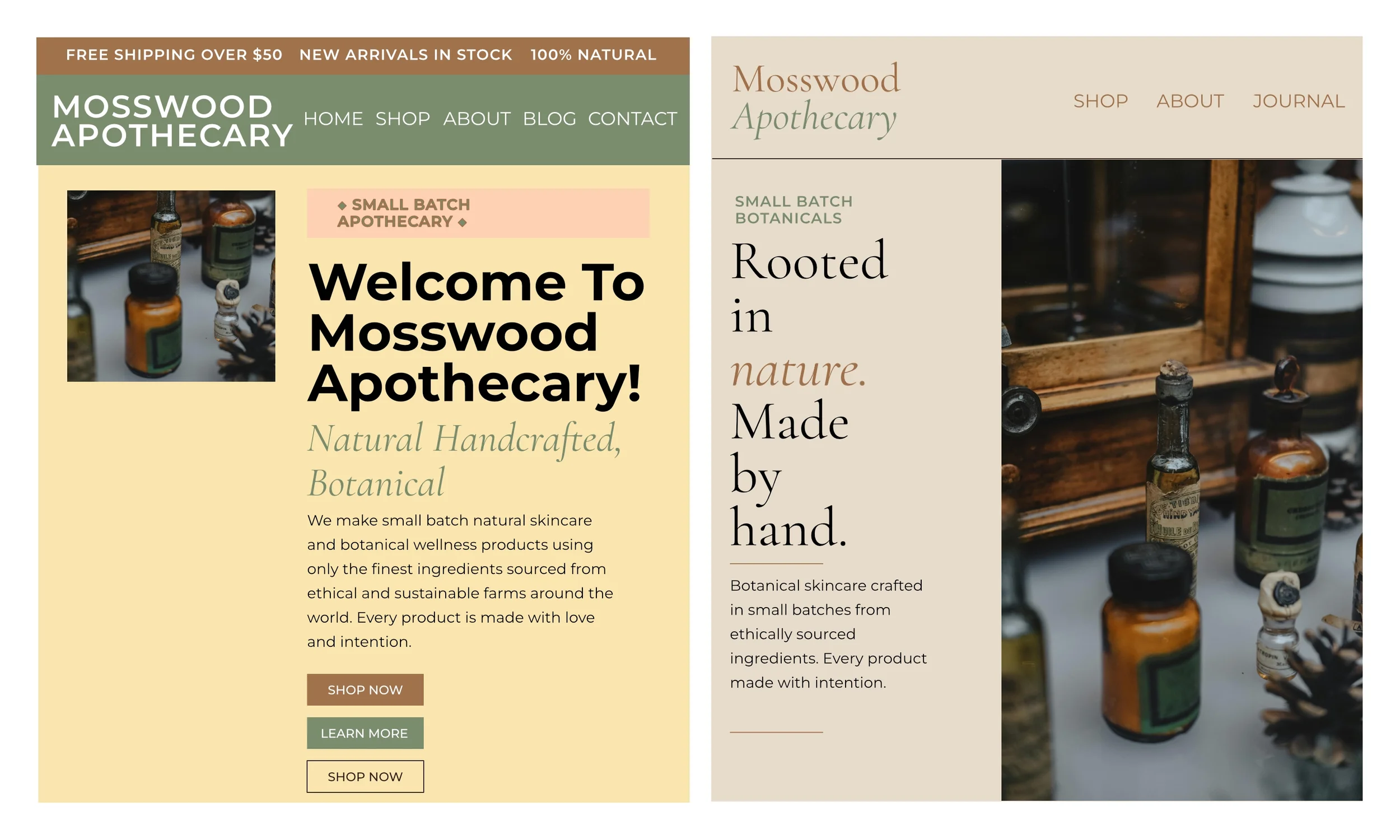
Same brand. Same product. The only difference is the design decisions behind it. Left is what happens when everything gets added. Right is what happens when everything gets edited.
The left version is not wrong in its intention. Every element on it is there for a reason the badges communicate values, the buttons give options, the announcement strip shares a promotion. But all of it together creates visual chaos. The eye does not know where to start so it does not start at all.
The right version has less on it. That is the point. Every element that is not absolutely necessary has been removed. What remains has room to breathe and a clear job to do. And because of that the brand immediately feels considered, premium, and trustworthy.
— SIX PRINCIPLES THAT SEPERATE CHEAP FROM EXPENSIVE —
01 Use fewer colors
High end brands almost always work with a restricted palette. Two to three colors maximum used consistently. One dominant background color, one text color, one accent used sparingly. The moment you add a fourth or fifth color the design starts to feel busy and unpredictable. Pick your palette and commit to it everywhere.
02 Commit to two fonts and only two
One serif for headings and display text. One sans serif for body copy, labels, and buttons. That is it. Mixing three or four fonts is one of the fastest ways to make a brand look unpolished. The two font rule applies to everything: your website, your business card, your social graphics, your email signature. Consistency is what makes it feel designed rather than assembled.
03 Give everything more space than you think it needs
Padding, margins, line height, the gap between sections, all of it should be more generous than your instinct tells you. Whitespace is not wasted space. It is the thing that makes everything else feel intentional. If your design feels a little empty you are probably getting closer to right. The brands that look expensive are the ones that are not afraid of empty space.
04 One call to action per section
Three buttons in a hero section is not giving the visitor options. It is creating indecision. High end brands know what they want the visitor to do and they ask for one thing at a time. Shop now or learn more or book a call, not all three in the same breath. Every time you add a second button you dilute the first one. Pick the most important action and ask for it clearly.
05 Let your typography do the heavy lifting
Most brands underestimate how much work good typography does. A well chosen serif headline at the right size with the right line height and letter spacing conveys more about your brand than any logo or color choice. The brands that feel most premium are often the ones with the most restrained visual elements and the most considered typography. Size, weight, and spacing are your tools.
06 Remove anything that does not earn its place
Badges, icons, decorative elements, announcement strips, pop-ups, social proof widgets, every one of these adds visual noise. Before you add an element ask what job it is doing. If the answer is not clear and specific it probably does not need to be there. High end design is edited design. The question is not what to add. It is what to take away.
“Premium design is not about what you have. It is about what you choose to leave out.”
— WHAT THIS MEANS FOR YOUR BRAND RIGHT NOW —
You do not need a bigger budget to apply any of these principles. You need a clearer eye. Go look at your website, your business card, your social profile. Count how many colors you are using. Count how many fonts. Look at how much space you are giving your content. Ask yourself what you could remove.
Most brands improve dramatically not by adding something new but by taking something away. A logo without the tagline underneath it. A hero section with one button instead of two. A color palette reduced from five to three. These are not design skills. They are editing skills. And editing is something anyone can learn.
A quick self audit for your brand
- How many colors are you using across your brand? Aim for three or fewer.
- How many fonts are you using? Aim for two.
- How many buttons appear in your hero section? Aim for one.
- When did you last remove something from your website rather than add to it?
- Does every element on your homepage have a clear and specific job?
If you answered those questions and felt uncomfortable about any of them that is actually a good sign. It means you can see clearly what needs to change. And seeing it clearly is always the first step.
The brands that look expensive are not the ones with the biggest budgets. They are the ones that made deliberate choices and had the confidence to leave everything else out. That confidence is available to every brand regardless of how much they spent on their logo or their website or their business cards.
It starts with one decision. Then another. And then another. Until the whole thing feels like it was designed on purpose, because it was.
The Eranova Design template collection is built on every one of these principles. Every layout. Every color choice. Every font decision.
Browse the full collection on Gumroad.